


Travel Stress in Dogs and Cats: How to Help Your Pet
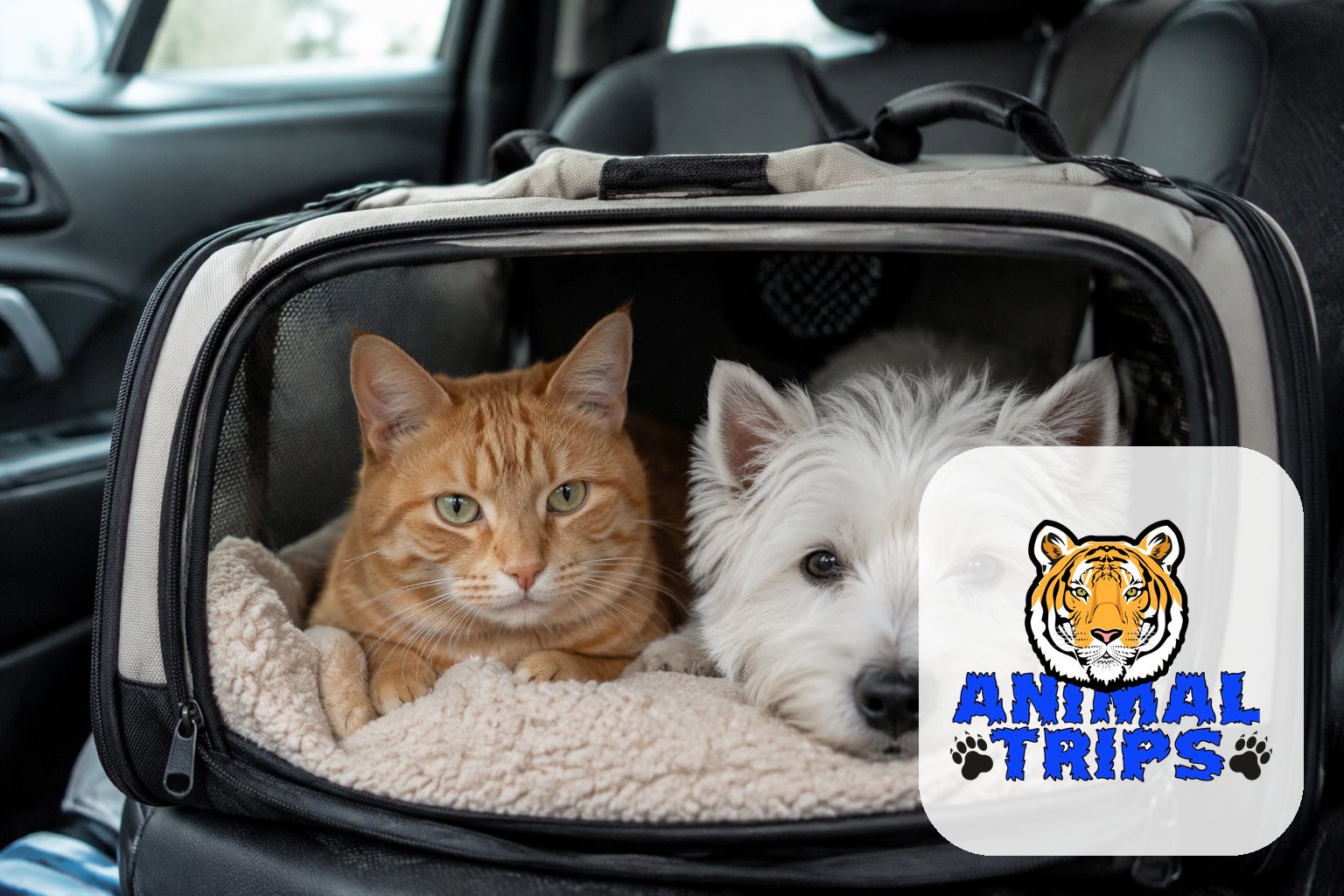
Lip licking, heavy breathing, whining or complete freezing — your animal is telling you the journey is overwhelming, just not in words. The good news: travel stress can be reduced, and often trained away entirely. Here is how to read the signals, what works, and what only makes things worse.
How animals show stress
A dog under travel stress most often: licks its lips and nose, yawns “without tiredness”, pants heavily at normal temperature, trembles, whines or barks, tries to escape the carrier, drools heavily, refuses treats. A cat signals differently: freezes motionless with wide eyes, meows low and continuously, breathes shallowly with an open mouth (an alarm signal — in cats it means serious discomfort), over-grooms or vomits. In both species, upset stomachs in the first hours of the trip are also common.
The stress scale: when to intervene
- mild (yawning, lip licking, restlessness): your calm behaviour, shorter sessions and breaks are enough;
- moderate (panting, whining, refusing food for the whole trip): behavioural training plus pheromones;
- severe (vomiting, diarrhoea, aggression, panic escape attempts, open-mouth breathing in cats): discuss a pharmacological plan with your vet — this is not “caprice”, it is a physiological reaction.
Training that works: desensitisation + counterconditioning
The most effective method is gradual exposure to the stimulus paired with reward. The principle is simple: travel = good things happen. A 2–4 week scheme:
- the carrier stands open at home with a blanket and treats — the animal walks in by itself;
- short sessions in the closed carrier at home, then carried into the car without driving;
- 2–5 minute drives ending with a walk or play;
- lengthening the trips by 5–10 minutes every few days up to the target duration.
Key points: never end a session in a moment of panic (step back and finish on calm) and do not outpace the animal. For puppies we describe this process in detail in the article on the puppy’s first trip.
What helps: pheromones, smells, sound
- pheromones: Adaptil (dogs) and Feliway (cats) as a carrier spray — spray the blanket 15 minutes before putting the animal in; for most animals they work as a gentle calming scent;
- the smell of home: an unwashed blanket or your T-shirt in the carrier;
- sound: quiet, calm music or an audiobook masks road noise; there are even “for dogs” playlists with a proven calming effect;
- view: some dogs are soothed by seeing the owner, others prefer a covered carrier — test before the trip;
- chews and Kongs: long chewing lowers the heart rate — a frozen Kong with pâté is a classic for 1–2 hours of calm.
Pharmacology: when and what
For moderate and severe stress a vet may prescribe: gabapentin (especially effective in cats, given 2–3 hours before departure), trazodone or alprazolam (dogs, short-acting), and for motion sickness Cerenia (maropitant). Safety rules:
- test every new medication at home several days ahead — reactions can be individual;
- avoid acepromazine (ACP): it immobilises the animal but does not remove fear — a dog “frozen with terror” is a worse scenario than a whining one;
- do not give human medicines (including benzodiazepines) without a vet’s dosage;
- supplements (L-theanine, casein, CBD where legal) act gently and are best started 2–4 weeks before the trip.
What not to do
- do not comfort hysterically — “oh you poor thing” amplifies fear; speak calmly and matter-of-factly;
- do not punish whining or vomiting — these are symptoms, not naughtiness;
- do not feed for 3–4 hours before the trip;
- do not open the carrier “just for a second” while driving;
- never leave the animal alone in a heated car — the temperature rises 10 °C in 10 minutes.
Logistics that lower stress
Your day plan affects the animal more than supplements: an early morning start (cooler, less traffic), stops every 1.5–2 hours, a steady 20–22 °C, the same carrier and blanket as at home, a predictable rhythm. If the animal still copes very badly, consider specialist transport — our drivers drive calmly, make stops tailored to the animal and send you photos, so the stress passes not only for the pet but for you too. For the special needs of flat-faced breeds read the article on brachycephalic dogs, and for older animals — the guide to transporting seniors.
“Calm journey” checklist
- 2–4 weeks ahead: carrier training and short drives;
- pheromone spray on the blanket 15 minutes before leaving;
- last meal 3–4 hours before, water available;
- a frozen Kong/chew to start with;
- stops every 1.5–2 hours, temperature 20–22 °C;
- vet-prescribed medication — only after a home test.
Bottom line
Travel stress is not a verdict — it is a signal that the animal needs either training or support. Read the signals early, act gradually and do not shy away from pharmacology when indicated. And if you would rather hand the journey to people who do this daily — request a quote.